


About Metal Prints
Metal prints are not a trend or a novelty. They are the highest-performing photographic medium available for large-scale, architectural environments.
When executed correctly, they do not look like artwork. They look like windows.
This page explains exactly why.
What Is a Metal Print?
Each piece begins with a sheet of recycled aluminum.
A specialized coating is applied to the surface: a white backing layer beneath a clear polymer layer. At high heat, archival dyes are infused directly into that polymer. The image does not sit on top of the surface. It becomes part of it.
Because light passes through the dye, reflects off the white backing, and returns back through the color before reaching your eye, the image appears luminous and dimensional. Many viewers ask whether the artwork is backlit. It is not.
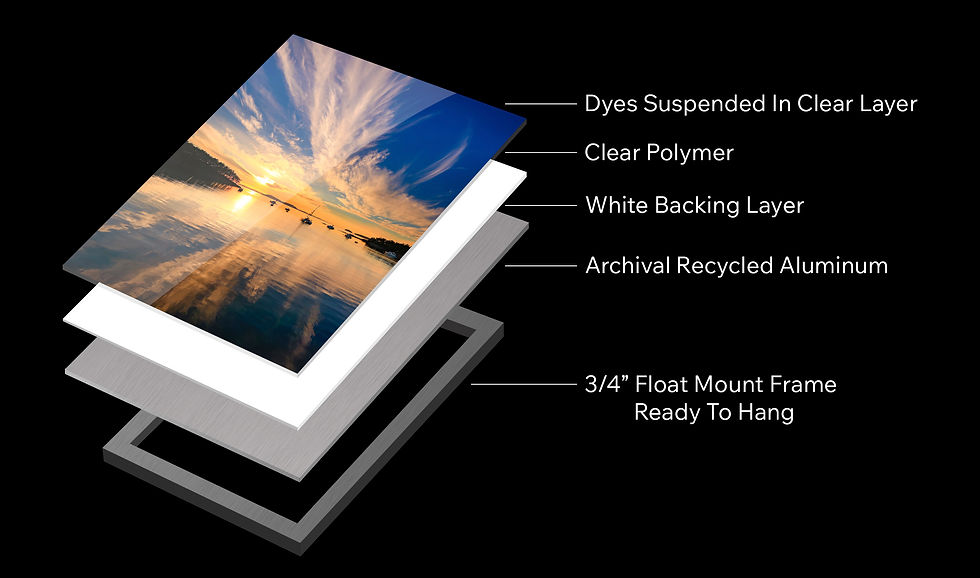
This optical structure is what gives the work its clarity, depth, and lifelike presence.
For photography created at extreme resolution and scale, no other medium performs at this level.
Why Metal Prints Outperform Paper, Canvas, and Acrylic
Most photographic prints are still produced on paper. Paper relies on chemical processing, is vulnerable to moisture, and will visibly fade within decades.
Canvas softens detail, reduces contrast, and shifts a photograph toward a painterly look. That may suit certain aesthetics, but it diminishes the realism and depth that define high-resolution wilderness photography.
Acrylic face-mount presentations place a sheet of photo paper behind a thick layer of clear plastic. While visually bold at first, the underlying paper remains subject to long-term fading.
Acrylic surfaces can scratch, introduce glare under direct lighting, and add significant weight.
When the image eventually fades, the large plastic panel remains. The result is a substantial synthetic object with limited recyclability and a shortened lifespan.

Metal prints differ fundamentally. The image is infused directly into a durable aluminum surface rather than mounted behind plastic or sealed beneath glass. There is no paper core to deteriorate and no thick synthetic layer creating waste.
Metal Prints Offer:
• Archival color stability lasting three to four times longer than traditional photo paper
• Waterproof surface with no need for protective glass that can be easily cleaned if necessary
• Scratch-resistant coating for everyday durability
• Frame-free presentation that maximizes image size within the same wall space
• Lightweight construction for simplified installation
• Recycled and fully recyclable aluminum substrate
For collectors and institutions seeking permanence, clarity, and environmental responsibility, metal delivers structural integrity and long-term performance that other mediums cannot match.


Color Longevity and Archival Performance
Xenon light stability testing demonstrates that dye-infused metal prints maintain image integrity significantly longer than traditional silver halide photographic papers.
Standard metal prints displayed out of direct sunlight show no noticeable fading for approximately 60 to 80 years. Traditional paper prints including ones under acrylic often show fading in 15 to 20 years.
For environments exposed to direct sunlight or continuous UV, our Superlife finish is available. This alternative dye set extends longevity approximately three times further without altering the visual appearance of the piece.
Superlife adds 20 percent to the investment and is recommended if the piece will receive more than 4-6 hours of direct sun per day and for all outdoor installations.
Performance in Healthcare, Hospitality, and Commercial Spaces
Corporate offices, medical facilities, and hospitality environments require more than beauty. They require durability, hygiene compatibility, and long-term visual stability.
Metal prints offer:
• Non-porous, wipe-clean surfaces
• Resistance to moisture and humidity
• Compatibility with standard ammonia-free cleaning and sanitizing solutions
• Long-term structural integrity in controlled interior environments
• Simple locking mechanisms for secure installation


Exposure to nature imagery has been associated with reduced stress and improved well-being in workplace and healthcare settings.
For commercial buyers, the medium must support both psychological impact and operational practicality. Metal delivers both.
Outdoor Applications and Temperature Stability
Metal prints are engineered to expand and contract safely with temperature shifts.
The adhesive systems used in mounting are rated from approximately minus 40 degrees to plus 500 degrees Fahrenheit.
For outdoor installations, Superlife finish is strongly recommended.
All exterior pieces include locking T-screws and French cleats to secure the artwork against wind movement.


Mounting and Floating Presentation
Each metal print includes an inset aluminum subframe mounted to the back.
This hidden structure:
• Creates a 3/4 inch float from the wall
• Supports picture-hanging wire or French cleat systems
• Distributes weight evenly
• Allows large-scale pieces to hang cleanly without visible hardware
The absence of glass, mats, and traditional frames allows more image within the same footprint.
The result feels architectural rather than decorative.
Cleaning and Care
Metal prints require very little maintenance. Because the surface is smooth and non-porous, they rarely collect dust. In most environments, light cleaning once a year is more than sufficient.
If something does reach the surface, such as water spots, soap residue, or everyday splashes, it can be cleaned easily with a soft cloth and an ammonia-free glass cleaner.
For a streak-free finish, a simple 50/50 vinegar and water solution works exceptionally well.
Watch full cleaning video here.


The surface is waterproof and scratch resistant under normal conditions, making it well suited for bathrooms, kitchens, and high-traffic spaces.
As with any fine art, edges should be protected from impact. Aluminum can bend under force, and the surface may chip if struck directly on a hard edge.
Handled correctly, these pieces are built to last for generations.
Sustainability and Environmental Responsibility
Traditional photo paper production relies on chemical processing and heavy metals like silver.
Dye-infusion metal printing eliminates chemical baths and minimizes environmental waste.
The aluminum substrate is recycled and fully recyclable.
Longevity itself is an environmental advantage. When artwork lasts decades longer, replacement cycles decrease.


Signature and Provenance
Each piece is signed in the lower right corner.
Collectors of limited edition pieces receive a hand-signed Certificate of Authenticity with a unique serial number corresponding to the piece.
These are documented works of art created for long-term stewardship.
Addressing Common Concerns
Our gallery pieces are displayed with an ultra high gloss finish because it delivers the greatest depth, contrast, and dimensional realism. The surface captures available light and reflects it back through the image, which enhances clarity and makes the artwork feel lifelike.
While the finish is reflective, normal room reflections do not obscure the image. Your eye naturally adjusts and focuses on the photograph itself. Direct light fixtures, however, can create visible reflections if aimed straight at the surface.
If you choose to install track lighting to intensify color and impact, we recommend mounting it close to the wall, typically 12 to 18 inches out, depending on the artwork height. This positioning illuminates the piece without creating unwanted reflections.
For spaces with unavoidable glare, we offer a satin finish that maintains rich color with minimal reflection. It does not have the same depth as gloss, but it performs well in challenging lighting conditions. Samples of both finishes are available in our galleries upon request.
Premium metal prints are designed for longevity. They resist fading, moisture, and wear far better than paper or canvas based media, making them a long term solution for homes and commercial spaces that expect durability and visual consistency over many decades.
Under normal indoor display conditions, our metal prints maintain their color integrity for approximately 60 to 80 years with no noticeable fading. This is roughly four times the color stability of traditional photographic paper prints and photo paper based acrylic prints, which often show visible fading within 15 to 20 years.
For spaces with direct sunlight exposure, we recommend upgrading to our Superlife finish. This option utilizes advanced UV-resistant dye technology, extending color stability up to four times beyond the standard finish. Superlife prints are available for a 20 percent investment premium and are visually identical to the standard finish, offering enhanced durability without altering the aesthetic.
Each piece is professionally packaged, fully insured, and arrives ready to hang.
Works 60 inches wide and smaller are fitted with professional picture hanging wire and can be installed using standard heavy duty picture hooks. Pieces 48 inches wide and larger are equipped with a French cleat mounting system for added stability and precise alignment.
You will receive a detailed installation video with clear, step by step guidance to make the process straightforward and confident.
If you prefer professional assistance, we are happy to recommend trusted local installers in your area upon request.
In-gallery viewing and calibrated mockups provide high-fidelity previews. Screen brightness is typically higher than real-world wall lighting, and expectations are set clearly in advance.

Why This Medium Matters at Large Scale
When artwork exceeds four feet wide, every flaw becomes visible. Paper softens. Canvas blurs. Acrylic can distort reflections.
Metal preserves microscopic detail.


For large-format wilderness photography designed to dissolve the boundary between interior space and the natural world, this performance is not optional. It is essential.
The precision and depth captured in Peter James’s ultra-high-resolution images demand a medium capable of holding that level of clarity. When infused into aluminum at scale, the result is a true-to-life visual experience that feels less like viewing a photograph and more like standing in the landscape itself.